The French Iron Lady – iron innovations revealed in the Notre Dame Cathedral


The French Iron Lady – iron innovations revealed in the Notre Dame Cathedral.

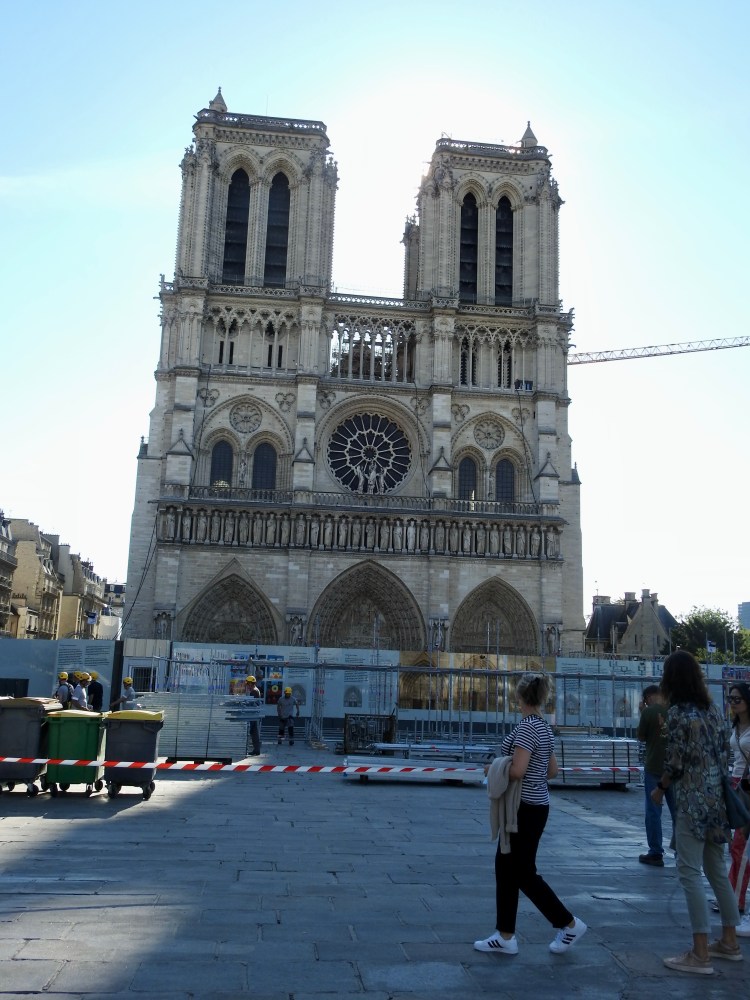
The renovations to the Notre Dame Cathedral in Paris after the April 2019 fire has revealed the architect’s innovative use of iron. It was ahead of its time – high tech and ultra modern – for Gothic architecture! This is a surprising and unexpected revelation for the renovation team. 

So, before the United Kingdom’s Margaret Thatcher – known as the Iron Lady – prime minister from 1979-1990, there was the French Iron Lady – or rather, the French Iron Dame – the Notre Dame Cathedral. 

Maxime L’Héritier at Paris 8 University Vincennes-Saint-Denis in France and the renovation team have unearthed design innovations that have been unknown until now. Renovations are continuing – estimated to continue into 2025 – and this is not the time for analysis, says Maxime L’Héritier, but glimpses of architectural design elements already reveal the cathedral’s innovations.

Notre Dame Cathedral was the tallest building in Paris when construction began in medieval times – during the 1160s. And now the renovation team has estimated that the construction used thousands of iron staple reinforcements from the floors to the upper walls. This is the first Gothic cathedral known to have used this method of reinforcement.

The fire on 15 April 2019 was caused by a spark while undergoing planned repairs and renovations to the roof. The fire destroyed the whole roof and the spire, which fell spectacularly during the fire. Water and fire-fighting materials led to water damage and the fear of total collapse. Subsequently, massive renovations to restore the cathedral in its truest form have continued almost immediately after the assessment of the fire damage. 

During the post-fire renovations, the team found large iron staples holding together the building’s stone blocks – making the cathedral’s architecture a ‘modern marvel,’ the New Scientist wrote in March 2023.

Maxime L’Héritier says that the iron staples were not visible before, but due to the framework burning, it made some staples visible to the renovation team. 

They found 12 iron staples, with each one measuring about 50 centimetres (almost 20 inches) long and weighing 2-4 kilograms.

Sample of iron staple reinforcements; Source: 10.1371/journal.pone.0280945


Researchers conducting preliminary analysis of the iron staples and the cathedral’s history show that they were used in the earliest stages of construction. Researchers used radiocarbon dating analysis on the staples – made of an alloy of carbon and iron. They dissolved the iron staples to leave behind the carbon that originated from charcoals used in medieval ironworking furnaces. They documented their findings in a research paper in Plos One (15 March 2023). Therefore, the use of iron made the building lighter than the Roman stone cathedrals of the time, and was crucial to the Gothic design of Notre Dame’s tall structure.  

The research also shows that many of the ironworking sites, where the original architect sourced the iron staples, were within a day’s walk from Paris, says L’Héritier. This ‘archaeological sleuthing process’ involves using lasers to pulverise the iron samples so that they can undergo analysis with a mass spectrometer, which allows for the chemical signature comparison. 

But, as Maxime L’Héritier says,

‘Now is not diagnosis time – it’s restoration time.’

There will be time later for further diagnosis to determine more of the Iron Dame’s architectural secrets.

Journal reference PLOS ONE DOI: 10.1371/journal.pone.0280945

Reference: L’Héritier M, Azéma A, Syvilay D, Delqué-Kolic E, Beck L, Guillot I, et al. (2023) Notre-Dame de Paris: The first iron lady? Archaeometallurgical study and dating of the Parisian cathedral iron reinforcements. PLoS ONE 18(3): e0280945. https://doi.org/10.1371/journal.pone.0280945

Source: https://doi.org/10.1371/journal.pone.0280945

The Banquet of Bread – portraits of artisanal bakers in Paris 


The Banquet of Bread – portraits of artisanal bakers in Paris.

Bread is the ‘staff of life’ – or as some say, the ‘stuff of life’ – everywhere in the world. Bread and its bakers sustain life – le pain et ses boulangers soutiennent la vie

There are many references to bread in James Joyce’s novels on life in Dublin in the early 20th century – with much of his writing undertaken during his 20 years residing in Paris, where his lived on plain bread when he was poor, and bread with wine when he had money. 

Many of Joyce’s references are related to bread broken as a religious ritual, and common idioms, such as:

‘bread, the staff of life, earn your bread’ and ‘he knows which side his bread is buttered.’

There are references to: bread, butter and honey; thick slices of bread impaled on his knife; bread to sop up gravy; unleavened shewbread; bread of angels; brawn and bread; bread and onions; fried bread; brown bread with golden syrup; and pellets of new bread with fennygreek and gumbenjamin swamped down by potions of green tea. Bread was indeed the staff of his life.

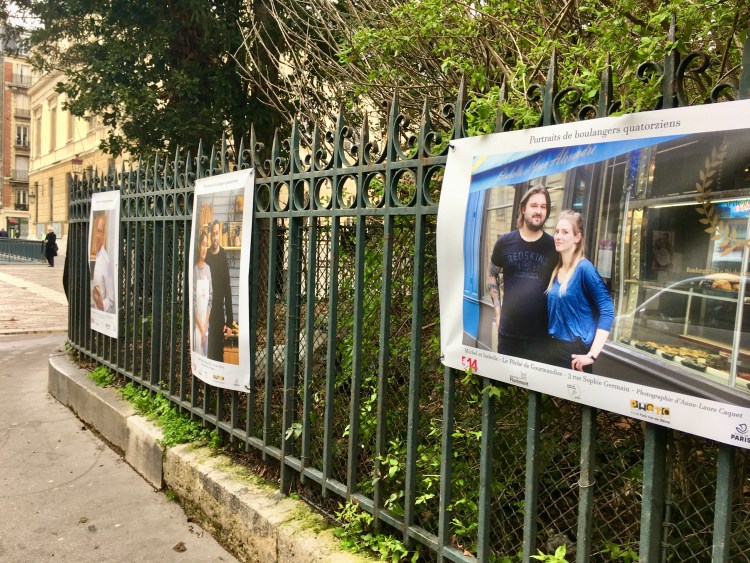
The town hall of the 14th arrondissement is presenting an exhibition on its fence grilles called “Portraits de boulangers quatorziens” – Portraits of the Bakers of the 14th – i.e. portraits of artisanal bakers of the 14th arrondissement of Paris. The exhibition, from 6-20 March 2023, celebrates its local bakers and is a precursor to the popular annual event in October called Le Banquet des Pains – The Banquet of Bread.

Photoclub Paris-Val-de-Bièvre took the photographs of the bakers in their own bakeries. The photos were taken in conjunction with the associations, Graine de Quatorzien and Florimont, to celebrate the essential contribution of bakers and bakeries in our daily lives. 


Notre Dame Cathedral might re-open to visitors in December 2024


Notre Dame Cathedral might re-open to visitors in December 2024.

Notre Dame Cathedral might re-open to visitors in December 2024 due to the ‘good pace’ of the renovations. This will be after the 2024 Olympic Games in Paris and six and a half years after renovations first commenced, and almost four years after the fire that damaged the roof and spire, and water damaged the interior of the famous cathedral on 15 April 2019. Across France, every day about 1,000 people are working on the cathedral’s renovations.

On Monday 6 March 2023, French officials announced its aim to open the doors of Notre Dame Cathedral to visitors in December 2024. The cathedral’s spire will gradually start re-appearing this year, which is a ‘powerful signal’ of the 12th century cathedral’s revival, announced the army general in charge of the renovations, General Jean-Louis Georgelin. 

The reconstruction of the spire began in 2022 to recreate it as it was before the fire – i.e. a 93 metre (315 feet) tall 19th century Gothic style spire designed by architect Eugene Viollet-le-Duc.

To celebrate the announcement, there will be a free exhibition open to visitors from 7 March 2023 to 2024 in an underground facility in front of the cathedral. The exhibition is called “Notre-Dame de Paris: at the heart of the construction site.” It also features some remains from the fire. The free exhibition will be open during the 2024 Paris Olympic Games. There will also be a fee-paying virtual reality show that will present the cathedral’s history. 

Even though the aim is to re-open the cathedral in December 2024, all of the renovations will not be completed. Some renovation work will continue into 2025, said culture minister Rima Abdul-Malak. To date, there is still the framework to be completed, as well as painting the interior, and work on the stones, vault, organ, and stained-glass windows. The intention is to remain true to the construction methods of medieval times, said Philippe Jost, managing director of the government agency overseeing the reconstruction. And that takes research, sourcing the exact materials and artisans, and time.


The Grilles of the Luxembourg Garden: photography exhibitions


The Grilles of the Luxembourg Garden: photography exhibitions.

On the perimeter of the Luxembourg Garden – Jardin du Luxembourg – is a large black iron fence – railings topped with gold-coloured arrows. It is called the Grilles du Jardin du Luxembourg – the Grilles of the Luxembourg Garden.

In 1865, during Louis Napoleon’s reconstruction of Paris, the chief architect of parks and promenades, Gabriel Davioud, built this new ornamental iron fence, and gates, around the Luxembourg Garden. It has been undergoing renovations for about 14 months, since the end of 2021, to repair the grilles, paint them, and restore the golden arrows. 

The Grilles of the Luxembourg Garden are the property of the Senate of France – called Le Sénat. The Senate building is in the grounds of the Luxembourg Garden.

Since 2001, the Senate has made available the portion of the Grilles of the Luxembourg Garden between Porte Saint-Michel and Porte Odéon to cultural and art exhibitors. For a fee, exhibitors can present photography exhibitions to the public. Each year, the Senate schedules a program of photography exhibitions for a period of four months for each exhibition.

Exhibitors can show their photography on 83 standardized panels attached to the grilles. The panels, provided to exhibitors, are intended to format photographic prints of 120 x 180 centimetres (about 47 x 71 inches). The fees to hold photography exhibitions cover the costs of maintenance, storage, and depreciation of these panels.

The photography programs or events – evenementiel – are selected by the Exhibition Selection Commission, which meets at the beginning of each year.

Exhibition projects must be of an artistic or historical nature and be intended for the general public.

The exhibitors and their partners are responsible for the entire organization of the exhibition. For further information or applications, please send an email to evenementiel@senat.fr.


Power and flour – rising prices, but what about French bread?


Power and flour – rising prices, but what about French bread?

Due to the energy crisis and the Russia-Ukraine conflict, the cost of power and flour is rising across France and Europe. Electricity costs and the cost of flour is affecting local bread businesses – the local bakery, la boulangerie.

The French government has recently announced that French bakers will receive tax relief to keep their bakeries open. The tax relief will enable bakers to pay their taxes over a period of months in an effort to assist bakers. The announcement came after fears that many local bakeries will be forced to cut the number of working hours, and staff, or even go out of business.

The French government spent 34 billion euros in 2022 to keep power (energy) prices stable for businesses and households as the high cost-of-living crisis threatens the economy across Europe.

Bakeries are the bread and butter businesses in France – or the baguettes and croissants of business. They have a central role in French traditions. In March 2021, France applied to have the baguette given UNESCO world heritage status! UNESCO is yet to make a decision on that. However, in modern times, the boulanger has introduced a range of breads, cakes, pastries, and artisanal products to their arsenal. 

The French would revolt if they did not get their daily bread. They did revolt! During the French Revolution, in October 1798, Denis Francois did not open his bakery – and an angry mob lynched him for this despicable act! The French assembly passed a law to force bakeries to keep citizens fed. The amended legislation in 1957 gave town halls in Paris the power to regulate the opening hours of their local bakeries. The aim was to ensure the availability of bread everywhere. 

‘We can’t expect people to have to jump in a car to go in search of a loaf of bread,’ said a spokesperson of the Paris Chamber of Professional Bakers. 

The Bread Observatory says there are 35,000 bakeries in France serving 12 million customers every day, which is 6 billion baguettes every year. Euronews reported that 320 baguettes are eaten every second in France, with 50% of French citizens living within 2.2 kilometres (1.4 miles) of a bakery. In Paris, 73% of people live less than a kilometre (half a mile) from a bakery. That’s a five-minute walk to a bakery – 9 minutes for French rural folk.

So, the bakers’ law is well enacted. The Paris Chamber of Professional Bakers says there are less than 20 complaints each year about bakeries not being open.

But the price power and flour are rising. In 2022, the price of a baguette rose by 30 centimes (33 cents), which is an increase of 13% compared to 2021, reported Forbes.

A baker talking to Forbes magazine said,

‘After all, what is bread if not just flour, electricity, minimum wage, and gas?’

No truer word has been spoken! And that’s the power of flour!


Paris – City of Less Light for Christmas 2022, but it won’t dim the joy


Paris – City of Less Light for Christmas 2022, but it won’t dim the joy.

Due to the energy crisis, the Paris 2022 festive season will have a little less illumination in the City of Light.   

Local authorities are reducing the amount of festive-lit decorations this year to save energy and cut costs. They say the reduced lighting is a ‘subtle change’ which won’t dim the joy. 

For example, the 400 trees lining the Champs-Élysées won’t have their usual luminous hoops encircling them this December. Admittedly, the Champs-Élysées committee said that this is not a subtle change, in favour of a ‘drastically limited’ look designed to escape the soaring energy prices which have more than doubled in France. Instead, the trees will have millions of energy-saving LED lights that will be turned on for 6 weeks, rather than the usual 7 weeks, and will also be switched off 2 hours and 15 minutes earlier than usual, at 11:45 every evening, with the exception of December 24 and December 31. 

The Champs-Élysées committee said that this change is expected to use 11,500 KWH, which is 44% less than the amount of electricity used in 2021 to turn on the tree lights. Marc-Antoine Jamet, chair of the Champs-Élysées committee, said,

‘Total consumption on the Champs-Élysées will be the same as two people living in a 50-square-metre apartment’ and added, ‘it’s still very joyful.’

Paris officials have also reduced the number and size of outdoor ice rinks and Christmas market hours and the heating of market stalls to reduce electricity. However, there are already more tourists this year, compared with 2021 which had enforced travel restrictions due to the Covid-19 pandemic. 

The light reductions were instituted before the festive season. In August 2022, President Emmanuel Macron warned that high energy prices, caused by the Russia-Ukraine war, could signal ‘the end of abundance.’

Since September 2022, the City of Light has been the City of Less Light. Monuments, shops, and offices have dimmed their lights. The government imposed restricted hours of illuminated neon lights, screens, and shop windows – with the order to turn off at 10:00 pm – except the Eiffel Tower which keeps its lights on until the last tourists leave at 11:45 pm, instead of the usual 1:00 am lights-out. The mayor of Paris, Anne Hidalgo, said that the ‘energy sobriety’ plan aims to cut energy use by 10% and save about 10 million euros ($10.2 million).

Street lights are left on at night for safety reasons, and so are the lights on all of the bridges over the River Seine. 

In addition, thermostats have been lowered in swimming pools and public buildings, and residents have been asked to reduce the temperatures in the homes – despite the near freezing winter weather. 

Nevertheless, Parisianers have largely been in favour of the energy-saving measures which are designed to be environmentally friendly as well as cost-effective.


The Crossed Bridge: from butcher to bookshop to café


The Crossed Bridge: from butcher to bookstore to café.

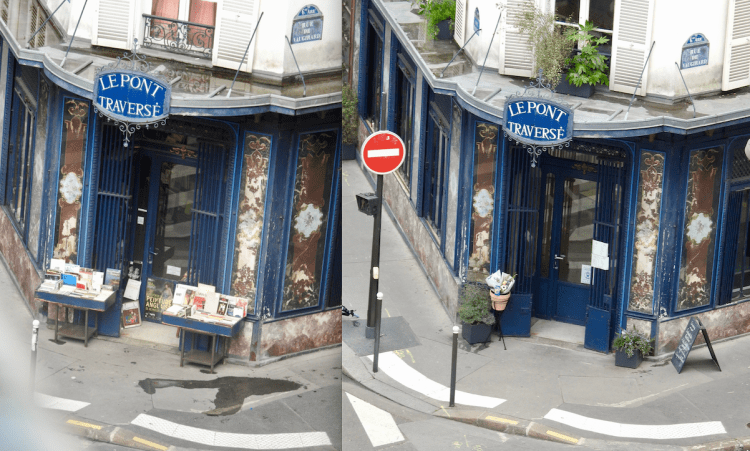
At 62 Rue de Vaugirard in the 6th arrondissement of Paris is Le Pont Traversé: The Crossed Bridge. Once a bookstore, and now a café.

Le Pont Traversé has a history. 

The writer and poet Marcel Béalu (1908-1993) founded the bookstore in 1949. 

He was born on 30 October 1908 in Selles-sur-Cher and worked in a haberdashery making hats while teaching himself classical French literature. His wife Marguerite Kessel encouraged him to study German literature too. 

He established a bookstore in 1949 and named it Le Pont Traversé after Jean Paulhan’s 1921 story. Marcel Béalu also wrote his own poems in two noted collections: Poèms 1936-1960 (Le Pont Traversé) and Poèms 1960-1980 (Le Pont Traversé). His store specialized in rare and second-hand books, illustrated book editions, modern literature, and surrealist literature.

But Le Pont Traversé, like other well-known bookstores in Paris (such as Shakespeare and Company Bookstore), did not begin where it ended. 

Le Pont Traversé began on Rue de Beaune, and moved to 16 Rue Saint-Séverin, where he also printed the journal Réalités Secrètes with René Rougerie from 1955-1971.   

In 1973, Marcel Béalu moved the bookstore to 62 Rue de Vaugirard, previously a butcher shop. It was an ideal location near the Luxembourg Garden and not too far from the Odéon.He painted his bookstore deep blue with carved ox heads and enamelled plaques. 

After his death in 1993, his second wife Marie-Josée Comte-Béalu managed Le Pont Traversé. It closed permanently in December 2019. 

Only one of Marcel Béalu’s books was translated into English during his lifetime, in 1991, published in French circa 1945 – L’Expérience de la Nuit – The Experience of the Night

On 15 November 2022, his 1954 novella (written in the 1940s) L’Aventure Impersonnelle – The Impersonal Adventure – was published in English. I’m now trying to find the 1993 Lys Flowerday 12-minute animated film inspired by and narrated by Marcel Béalu, called Petite Jeune Fille dans Paris – A Slip of a Girl in Paris. Great title!

Le Pont Traversé is now a café, open since March 2021.


Rueil-Malmaison – home of Napoleon and Josephine and the Imperial Jubilee


Rueil-Malmaison – home of Napoleon and Josephine and the Imperial Jubilee.

Commune Rueil-Malmaison is the hometown of General Napoleon Bonaparte before he became Emperor of France. He married his first wife Josephine de Beauharnais in 1796. She bought the Château de Malmaison in Rueil-Malmaison in 1799, a run-down manor house on 150 acres of woods and meadows, for 300,000 francs. It was cheap, it was near Versailles, and it was only 12 kilometres (7 miles) from the centre of Paris – in the western suburbs. 

Josephine commenced renovations to the manor and turned it into a castle – Château de Malmaison. She stayed in the Château after their divorce in 1810 until her death in 1814.

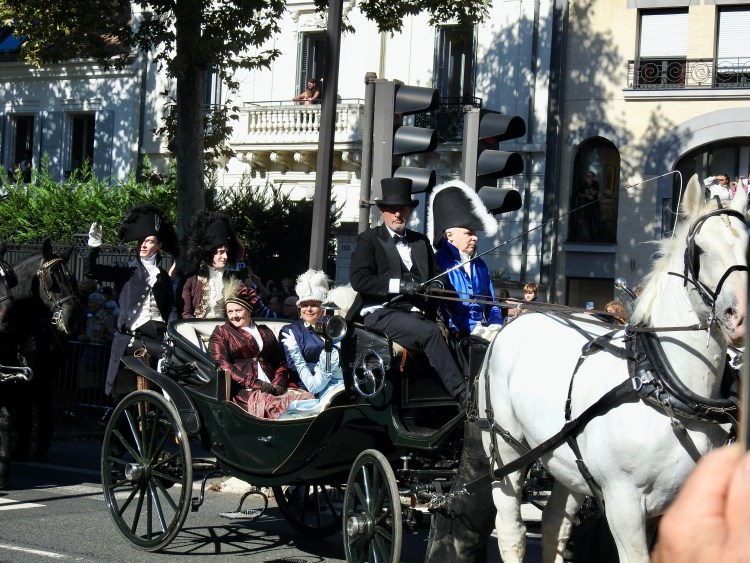
To boost tourism in Rueil-Malmaison, every two years the commune holds the Jubilé impérial– The Imperial Jubilee – also known as Napoleon Bonaparte’s parade. The Imperial Jubilee commenced 10 years ago in 2012, but being held every two years, this year was its 4th season. 

From 19-25 September 2022, Rueil-Malmaison showcased events to re-live the citizens’ lives under the Empire with Napoleon Bonaparte and Josephine – court life, military life, and civilian life – culminating with a parade on Sunday 25 September. 

The theme for the 2022 Imperial Jubilee was the beginning of the Empire and the establishment of the Court in 1804 – and dedicated to the legend of the Eagle. 

Napoleon Bonaparte established an innovative court, that was not an imitation of Versailles, nor the Holy Roman Empire, nor the major European courts. Instead, the new court drew upon sources of Roman antiquity, the French tradition, and the customs of the great European courts.

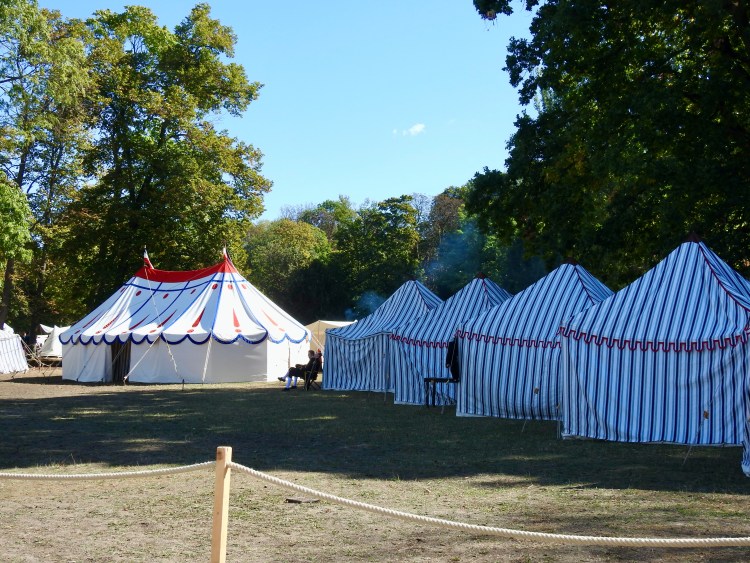
The parade participants camped in a nearby park for the duration of the celebrations, which was also open to the public to view  ‘camp life’ of the 1800s.