French Foreign Legion on parade on France’s National Day.
The French National Day – Fête Nationale – known as Bastille Day, is celebrated annually on 14 July. The holiday is celebrated with parades, an aerial flyover, and fireworks.
One of the groups marching in the parade included representatives of the French Foreign Legion – Légion étrangère.
The Foreign Legion is a corps of the French Army that includes infantry, cavalry, engineers, and airborne troops comprising uniquely of foreign nationals from a range of countries.
It was established in 1831 during the army’s activities in Africa to train foreign recruits willing to serve in the French Armed Forces. There are about 9,000 foreigners, called legionnaires, serving in the Foreign Legion.
Those who serve for more than three years can apply for French citizenship. Those who are wounded serving France can immediately apply for citizenship due to the provision known as:
‘French by spilled blood’ – ‘Français par le sang versé.’
Their logo is a gold grenade and their insignia flag is red and green – diagonally top left to bottom right (red on the top half and green on the bottom half) – with the gold grenade in the centre.
Rue du Fouarre – from illustrious to dirtiest to unknown but interesting.
Rue du Fouarre in the 5th arrondissement of the Sorbonne district of Paris has a changeable history, but remains a location for education. In the 13th century, it was called ‘the most illustrious street in Paris’ but by the 19th century, it was called ‘one of the dirtiest streets in the 12th arrondissement’ – at a time when it was part of the 12th district until the zones were re-named.
It is a short and narrow street of 50 metres long and 17.6 metres wide, starting at the intersection with Rue Lagrange (Barn Street) and ending at Rue Galande.
The street was created in 1202 when Mathieu de Montmorency and his wife Matilde de Garlande ceded their land to build houses. The street was called Rue des Écoliers (Schoolchildren Street) because one of the first schools in Paris was located on the street.
In 1264, the street name changed to Rue des Écoles (Schools Street) when the first University of Paris – La Sorbonne – and the College of Picardy were built in the location.
Around 1300, the street became Rue au Feurre (Hay Street) because schoolchildren sat on hay, or straw, when they attended classes. The spelling became Fouarre some time before 1320.
Author of Divine Comedy, Dante Alighieri (1265-1321), attended college in Rue au Fouarre under the tutelage of philosopher Siger of Brabant.
In 1358, Sorbonne University staff closed off the street at night with two doors – one placed at each end of the street.
In 1535, Parliament ordered the two doors to be placed there to prevent the public from accessing the street during the day because they were causing too much noise for the students.
Scholar and author of The Life of Gargantua and of Pantagruel, Francois Rabelais (born between 1483-1494, and died in 1553), wrote that his character Pantagruel studied on this street:
‘And first, on Rue du Fouarre, he defended his theses against all professors, students of fine arts, and orators, and put all their asses on the ground.’
Honoré de Balzac’s (1799-1850), in his novel Prohibition (L’Interdiction), wrote that judge Jean-Jules Popinot resided around the year 1828 in the Rue du Fouarre:
‘The Rue du Fouarre, a word that once meant Rue de la Paille [Straw Street], was in the thirteenth century the most illustrious street in Paris. There were the schools of the University, when the voices of Abeilard and Gerson resounded in the scholarly world. It is today one of the dirtiest streets in the twelfth arrondissement, the poorest district of Paris, the one in which two-thirds of the population lacks wood in winter, the one that throws the most marmots around the Foundlings, the most sick at the Hôtel-Dieu, the most beggars in the streets, which sends the most ragpickers to the corner of the terminals, the most elderly people suffering along the walls where the sun shines, the most unemployed workers in the squares, the most defendants in the Correctional Police.’
Rue du Fouarre was renovated and widened in 1887 and the southern part of the street joined Rue Lagrange, and adopted the name in 1890, thus shortening Rue du Fouarre to its present length.
Today, the façade of building at Number 6 shows signs of its school days, and is currently used for teaching French language classes. It lies close to the Seine, close to restaurants, the Sorbonne University, the Notre-Dame Cathedral, and the Shakespeare and Company English-language bookstore.
Appointments with Nature in Paris – June to August 2022.
This summer, 2022, the Jardin des Plantes (the Botanical Garden) in Paris is hosting many outdoor activities for people to discover the biodiversity of the Garden and reconnect with nature.
With the new ‘Les Rendez-Vous Nature’ (‘Nature Appointments’) event, there will be daily entertainment and activities from June to the end of August in a unique natural setting in the heart of Paris. The Botanical Garden’s scientific animators, gardeners, caretakers, researchers, and artists invite people of all ages to discover the riches of this historic garden: its plant and animal species, and its unusual corners that blend art and science.
There will be guided tours in the Garden and activities for children, such as land-art, storytelling, treasure hunts, and ‘Books in the Garden’ animations. In August, there will be a dedicated program to celebrate bats.
On the weekend of 23-24 July 2022, the Garden is hosting a nature, music, and poetry workshop, called ‘Pars les soirs bleus d’été’ (‘On Blue Summer Evenings’) to create natural perfume, introduce people to naturalist sounds, and encourage ‘sensitvie’ walks in the Ecological Garden.
The Jardin des Plantes Program : June to August 2022
Mondays:
• Flash animations at the Jardin des Plantes (from 11 July to 29 August) – from 6 years old – Free
• Guided tour “Nose to the wind in the Garden” (from 4 July to 29 August) – from 12 years old – Paying
• Meeting with the caretakers of the Menagerie – the zoo of the Jardin des Plantes (from 7 July to 1 September) – from 6 years old – Included in the price of the entrance ticket
Tuesdays:
• Workshop “The know-how of gardeners” (from 24 May to 30 August) – all public – Free
• Guided tour of the Ecological Garden (from 6 July to 16 August) – from 12 years old – Paying
• Meeting with the caretakers of the Menagerie – the zoo of the Jardin des Plantes (from 7 July to 1 September) – from 6 years old – Included in price of the entrance ticket
• Land-art creative workshop (from 12 July to 23 August) – from 3 years old – Paying
Wednesdays:
• Books in the Garden (from 6 July to 31 August) – from 3 years old – Free
• Tales in the Garden (from 6 July to 24 August) – from 6 years old – Free
• Flash animations “Animal sensations” at the Menagerie – the zoo of the Jardin des Plantes (from 13 July to 31 August) – from 6 years old – Included in the price of the entrance ticket
• Meeting with the caretakers of the Menagerie – the zoo of the Jardin des Plantes (from 7 July to 1 September) – from 6 years old – Included in the price of the entrance ticket
Thursdays:
• Workshop “Participatory science in the Garden” (from 2 June to 25 August) – from 8 years old – Free
• Guided tour “Eyes closed” (from 7 July to 25 August) – from 12 years old – Paying
• Outdoor meetings (from 14 July to 25 August) – all public – Free
• Flash animations at the Jardin des Plantes (from 11 July to 29 August) – from 6 years old – Free
• Flash animations “Animal sensations” at the Menagerie – the zoo of the Jardin des Plantes (from 13 July to 31 August) – from 6 years old – Included in the price of the entrance ticket
• Meeting with the caretakers of the Menagerie – the zoo of the Jardin des Plantes (from 7 July to 1 September) – from 6 years old – Included in the price of the entrance ticket
Fridays:
• Guided tour of the Jardin des Plantes (from 8 July to 26 August) – from 6 years old – Paying
• Theatre “For who wants to see” (from 8 July to 26 August) – from 8 years old – Free
• Flash animations at the Jardin des Plantes (from 11 July to 29 August) – from 6 years old – Free
• Flash animations “Animal sensations” at the Menagerie – the zoo of the Jardin des Plantes (from 13 July to 31 August) – from 6 years old – Included in the price of the entrance ticket
• Meeting with the caretakers of the Menagerie – the zoo of the Jardin des Plantes (from 7 July to 1 September) – from 6 years old – Included in the price of the entrance ticket
Saturdays:
• Meeting with the caretakers of the Menagerie (from 7 July to 1 September) – from 6 years old – Included in the price of the entrance ticket
• Wild listening: sound naps in partnership with Phaune Radio (from 9 July to 27 August) – from 6 years old – Free
Sundays:
• Guided tour “Investigation at the Menagerie, the green tea affair” (from 10 July to 28 August) – from 6 years old – Paying
• Meeting with the caretakers of the Menagerie (from 7 July to 1 September) – from 6 years old – Included in the price of the entrance ticket.
The Construction of Paris – building works block tourists’ views of city sites.
It is mid-2022 and summer is here – and so is the return of tourists to Paris after two or more years of the Coronavirus pandemic.
But, it is true that tourists cannot hide their disappointment that construction and renovations in the city are blocking their glimpse of iconic monuments and views of Paris, making memorable photographs difficult and almost impossible in some places.
‘It’s a shame,’ said a tourist, reported in the local newspaper, commenting on the construction in front of the Eiffel Tower, Notre-Dame Cathedral, and the Grand Palais.
Get used to it, dear tourists, because the building boom is here for the next few years.
The main reason for the current construction is the preparation for the Paris 2024 Olympic Games. There are over 70 infrastructure projects in progress for the construction of Olympics venues.
A large majority of the infrastructure is already built, while some are still emerging, such as the Olympic Village and the Aquatic Centre. The Olympic Works Delivery Company (Solideo) is expected to deliver all the infrastructure in early 2024 so that Olympic organizers have at least 3 months to take possession of the premises and test them for functionality.
Today, nearly 8,000 people are working on the infrastructure sites for the Paris 2024 Olympic Games, including about 1,000 on the Olympic Village.
The Olympic Village, near the municipalities of Saint-Denis, Ile Saint-Denis, and Saint-Ouen, will accommodate 14,000 athletes in 2024. The first construction works began in the second quarter of 2021, and it is now in the earthmoving phase to dig the foundations. In addition, more than 8,000 trees are in French nurseries waiting to be planted in the Olympic Village.
Near the Stade de France (the France Stadium) will be the Aquatic Centre for the Olympic Games water polo, diving, and artistic swimming events. Construction began in September 2021 and the Aquatic Centre is expected to be functional from April 2024.
One infrastructure expected to be finished earlier than the others is the Arena Porte de la Chapelle by September 2023. It is expected to have about 8,000 seats to host badminton and rhythmic gymnastics at the Olympics and also para-badminton and para-weightlifting events. However, it is expected that the Arena will also be able to host Le Paris Basketball at the end of 2023 for the Eurocup.
The transport construction for the Olympic Games will be delayed. The future Metro Line 16 to connect the Olympic venues in Seine and Saint-Denis will be two years late – i.e. ready in 2026. Metro Line 17 to the Media Village for the Olympics won’t be ready either. Only the extension of Metro Line 14 will be completed on time, which will connect the Olympic Village to Orly airport.
In readiness for the 2024 Olympic Games, hotels are being constructed and renovated, as are apartments for rent.
After the April 2019 fire and damage to the Notre-Dame Cathedral, its renovations will continue to at least 2024 in time for the Olympics, but possibly longer.
In Paris, energy renovation is also underway. What’s that? About 44 energy renovations have been launched since 2015 to significantly reduce greenhouse gas emissions in accordance with the city’s climate air energy plan. This will affect 3,600 public buildings (660 schools as well as kindergartens, child nurseries, libraries, and swimming pools). There will also be renovations (insulation of walls and ceilings, double glazing, etc.) in 5,000 social housing units and public buildings each year. This does not include private apartments.
The City of Paris has 250,000 social housing units, so the energy renovation will continue until 2050.
So, for residents and tourists alike, it seems like the entire city of Paris is under renovation or construction.
But tourists, don’t let the construction boom deter you too much from your Paris destination plans and getting around the city. There are plenty of monuments, galleries, museums, statues, churches, cathedrals, ruins, castles, sights, events, hotels, cafes, nightclubs, and restaurants to visit where you’ll still get a memorable photograph. Paris is, after all, still Paris!
Paris bouquinistes (booksellers) in the art of engraving.
The iconic bouquinistes (booksellers) along the river Seine in Paris have long been depicted in artwork and photography.
“The booksellers of the quays of Paris in contemporary printmaking” (“Les bouquinistes des quais de Paris dans l’estampe contemporaine”) exhibition will be held in the Paris Town Hall of the 6th arrondissement from 21 May to 13 June 2020. This exhibition is part of the Fête de l’Estampe – the Festival of Print.
Classified as French Intangible Cultural Heritage since February 2019, the bouquinistes have inspired more than 65 engraving artists in this exhibition over the past five years.
The exhibition is a complete panorama of the different engraving techniques gathered at the instigation of the cultural association of booksellers of Paris.
In colour or black and white, small and large, the works in this exhibition illustrate the many facets of this polymorphic engraving art that highlights this last small specifically Parisian craft still in activity.
Along the banks of the river Seine in Paris, the bouquinistes continue to sell second-hand books, just as they have done since the 19th century when the city permitted booksellers to have a permanent location.
Closed and locked at night, the typically green boxes sit on top of the parapet along a portion of the Right Bank and the Left Bank of the river for a length of about three kilometres. Open during the day, the boxes contain books, posters, cards, magazines, comics, prints, stamps, and papers. Their owners can choose when to open, because there are no specific ‘open’ hours – they can be open anytime from sunrise to sunset.
Since 1930, the government set strict regulations about the size, colour, and weight of the bouquiniste boxes. Each bouquiniste has a length of less than 9 metres for which they pay an annual fee to the city. Each box is identical and green. The length is 2 metres and the width is 0.75 metres to enable pedestrian access to the pavement. When open the upper edge of the box should not be more than 2 metres above the ground.
There are about 240 registered bouquinistes with 900 bouquiniste boxes. The bouquinistes of the Seine are now a UNESCO World Heritage site.
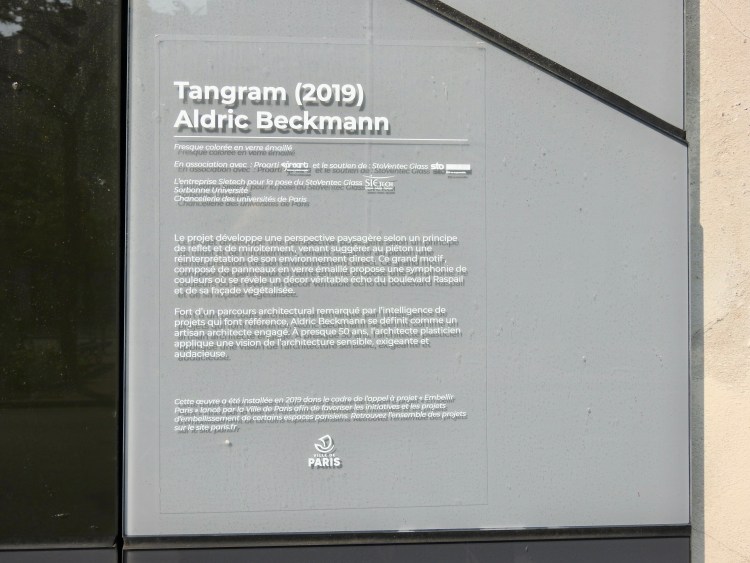
The Tangram Building in Paris is a building with a large, coloured fresco in enamelled glass, in the design of a tangram. A tangram is a puzzle consisting of flat polygons, called tans, which are constructed to form shapes.
The tans are used to create minimalist designs that are:
‘either appreciated for their inherent aesthetic merits or as the basis for challenging others to replicate its outline.’
Installed in 2019, visual architect Aldric Beckmann worked in association with Proarti and the support of StoVentec Glass, Sietech, Sorbonne University, and the Chancellery of the Universities of Paris.
The project develops a landscape perspective according to a principle of ‘reflection and shimmer’ reinterpreting the environment.
This work was installed in 2019 in the 6th arrondissement on the Boulevard Raspail as part of the “Beautify Paris” campaign launched by the City of Paris to promote initiatives and beautification projects in targeted Parisian spaces.