The buzz of bees in Paris

The buzz of bees in Paris.

Why did Napoleon love bees? He loved them so much that the bee became his signature emblem. It is said that bees were his symbol of tenacity. But bees are now very much a Parisian motif.
Scientists from the Institut National de la Recherche Agronomique (INRA-France) – the National Institute of Agricultural Research – wrote in the August 2014 open-access journal PLOS ONE, that there are more than 900 species of wild bees in France. It also stated that many were in decline, and hence they conducted their first comprehensive study in Europe to evaluate the impact of urbanization on the wild bee community in collaboration with the naturalist association Arthropologia. They found a considerable number of bee species in urban areas, and that they were actually more productive than their country cousins.

But Paris dwellers have a fondness for bees and honey and in preserving this special insect.

In the Luxembourg Garden – Jardin du Luxembourg– there has been a beekeeping school, an apiary school, since 1856, where it remains today. Henri Louis Hamet (1815-1889) founded the beekeeping school as part of the Central Agriculture Society. He was given a plot of land in the Luxembourg Garden to house 20 bee colonies. It was damaged in 1866 during Baron Haussmann’s reconstruction of Paris, destroying houses and streets to reconstruct new ones, but it was restored in 1872. Henri Hamet became known as the father of French beekeeping.

The wooden bee boxes can be seen near the fruit orchard in the Luxembourg Garden, and often the beekeepers themselves in their white netted uniforms, but it is fenced for protection, with signs not to walk on the grass. However, the bees have moved to modern bee boxes nearby that have copper tops. Its honey production is sold during the annual Honey and Bee Festival around Paris.

By the early 1990s in Paris, there were more than 1,000 bee hives until the Second World War (1939-1945). Paris now has about 400 hives, but beekeeping is a growing trend, with people establishing bee boxes on their roof or balcony. The hives must be registered and be more than 25 metres (80 feet) from a school or hospital.

In 2015, the Paris Opera established five bee hives – each with 50,000 bees – on the roof of the Palais Garnier, which are maintained by professional beekeepers. In 2016, it established an additional five bee hives on the terraces of the Opera Bastille. Paris Opera sells its honey production at Fauchon. Hotels and restaurants are also establishing their bee hives for their own use.

Why are there so many bees in Paris apart from the additional bee boxes? One reason is that in the early 2000s, Paris has been officially pesticide-free. Another reason is the occurrence of flowers all year round, again on people’s balconies as well as in parks and gardens. Yet another reason is that many Paris streets have Sophora trees – not native to the region – which blossom in August and attract bees. 

France is one of Europe’s main countries for the honey industry. Even 2020, with the Coronavirus pandemic, has not deterred the French honey production. In June 2020, vice-president of the beekeeping federation in Lille, Jean-Luc Debaisieux, said the spring honey production was three times better than usual due to the warm conditions. He described halfway into 2020 as ‘an exceptional year.’

In fact, Coronavirus confinement, restrictions, and lockdown have favoured the honey bee. The environment has been described as ‘calm’ in the meadows and embankments, increasing the bees’ pollen collection. And with people gardening more during the lockdown, planting flowers and vegetables, the bees have had more attractions to visit – quite unlike human species who have stayed away from tourist attractions. 

The Confessions of Jean-Jacques Rousseau and his good Theresa

The Confessions of Jean-Jacques Rousseau and his good Theresa. 

The Confessions of Jean-Jacques Rousseau is the autobiography of writer, composer, and philosopher Rousseau (1712-1778), written in 1782. 

Born in Geneva, his mother died in childbirth, and his watchmaker father raised him until the age of ten. From ten to sixteen years of age, he lived with his mother’s family. He left at the age of sixteen to travel—first to Sardinia and then to France. He reached Paris when he was thirty years old.

Rousseau’s autobiography is linear, commencing with his birth. Book 1 focuses on his childhood and apprenticeship from 1712-1728. Books 2 and 3 cover three years from 1728 from the age of sixteen, when he travels into ‘the vast theatre of the world’ and ends in 1731 having been in Sardinia. Book 4 is one year from 1731-1732 about his young loves. Book 5 from 1732-1736 includes the work years in Chambery in south-east France—and here his autobiography starts to get interesting and amusing. 

Book 6 is one year: 1736. He begins,

‘At this moment began the short happiness of my life, those peaceful and rapid moments, which have given me a right to say, I have lived.’

He continues,

‘I rose with the sun, and was happy; I walked, and was happy; I saw Madam de Warrens, and was happy; I quitted her, and still was happy!’

After some empty years in which he does not write at all, he resumes in 1741. In Book 7 he realizes that he has spent an idle youth, and as he nears thirty, he is determined to make changes—which covers 20 years in Books 7-11, predominantly in Paris, Geneva, and Venice. 

In Paris, he befriends Denis Diderot, a French philosopher and co-founder of the Encyclopedia. Rousseau contributes some chapters, including one on political economy written in 1755.

Rousseau also met Voltaire. These are his most productive years. Towards the end of these twenty years, from 1756 there are also the ‘good Theresa’ years. 

In Book 12, from 1762, he begins with ‘Here commences the work of darkness … the shame and the misfortune.’ Here are his confessions. It has taken a long time to get to his confessions. 

On his tears of joy after seeing Theresa again, after a two-month separation, he wonders why he hasn’t cried with joy more often. He berates himself for not expressing his emotions for her before, instead of being restrained in love. At the age of 56 in 1768, after 23 years living with Theresa, Rousseau finally weds his good Theresa. 

Rousseau was an influential figure of the times, transforming education and children’s rights, and changing the way people thought of music, the arts, and nature. His writing is easy-to-read, detailed, and quite fascinating.   

He is buried in the Pantheon in Paris.

Félix Potin building in Paris: renovated and revealed

Félix Potin building in Paris: renovated and revealed.

In October 2013, the Félix Potin turret was under wraps. Today the Félix Potin building has been renovated and revealed. 

The Félix Potin building is on the rue de Rennes in the 6th arrondissement of Paris. Rue de Rennes was originally designed to connect the Gare Montparnasse (the railway station) with the Left Bank of the river Seine – the river that bisects Parisian suburbs. When trains depart the Gare Montparnasse, one of their destinations is Rennes in Brittany, north-west France. Hence the street was named after the town Rennes.


In 1853, Baron Georges Haussmann, the town planner of Paris, wanted the street to reach the River Seine, and road construction and renovations commenced.

British historian, Richard Cobb, described rue de Rennes as “the most desolate, inhuman street in Paris” because its construction led to the destruction of many historical buildings.

By the late 1860s, the extension of rue de Rennes had only reached the Boulevard Saint-Germain. The northern extension was blocked by the Institut de France, the cultural institute. 

The Haussmann plans resurfaced every few years, with the recommendation to knock down the institute to continue the road to the river Seine, but by 1976 the idea was abandoned. 

On rue de Rennes is a department store built in 1904 as part of the Félix Potin grocery empire. Designed by Paul Auscher in the Art Nouveau style, the six-storey building has an exterior of moulded concrete casts. On the top is a turret – a free-form bell tower embellished with the name FELIX*POTIN in large, gold letters against a black background.

French architect Paul Auscher (1866-1932) designed several buildings for Félix Potin. The distinctive turrets bearing Felix’s name can still be seen at 103 Boulevard de Sebastapol (now a Monoprix store) and 45 rue de Rennes (now a Zara store). 

Félix Potin (1820-1871) was an innovative retailer who pioneered the manufacture of goods under one brand to sell in his own stores – mass distribution retail. He opened his first shop in Paris when he was only 24 years old. By 1860 he opened the first two-level retail store on the Boulevard de Sebastopol and in 1861 the Félix Potin factory in La Villette. In 1870, he started a home delivery service.

After his death, the business continued and another department store was built on rue de Rennes in 1904. By 1923 the business had 70 branches, 10 factories, 5 wine stores, 650 horses (for home delivery services0, and almost 8,000 workers. The American F.W. Woolworth Company chain of stores was based on the Potin retail model, with its first store appearing in 1879.

The business collapsed in 1996 and in 2003 the Societe Philippe Potin acquired the right to use the Félix Potin name for its distribution network in south east France.

So, the renovation of the Potin turret on rue de Rennes, completed in 2019, is a delight to see. And not just the turret, but the whole building. It is a large mosaic frontage with decorative advertising, in white against a pale-yellow background. The words, in English, can still be seen: THE LUNCHS PATISSERIE FIVE O’CLOCK. And Paul Auscher’s signature stamp is still etched into the cornerstone above the first floor. 


This image has an empty alt attribute; its file name is Front-Cover-6x9in-683x1024.jpg

French Asterix comics

French Asterix comics.

The Asterix comics are quintessentially French.

Its co-creator, Albert Uderzo, who teamed with Rene Goscinny to create Gaul Asterix (the character with the moustache), died this year in Paris on Tuesday 24 March 2020, aged 92 from heart failure. 

Albert Uderzo was born on 25 April 1927 in Fismes, in eastern France. He was born with 12 fingers, but had an operation to remove two of them. He grew up in Paris with his Italian parents.

Albert Uderzo and Rene Goscinny created the Asterix comic series in 1959—60 years ago. It was published by the Dargaud printing house. In 1966, France’s first space satellite was named Asterix in honour of the comic legend. The series is translated into more than 100 languages and there is even a theme park dedicated to Asterix. 

Asterix tells of the adventures of an ancient Gaul named Asterix resisting the Romans in 50 BC using a magic potion that gives him superhuman strength. Asterix is described as a weakling who defeats the strong. His friends include Obelix and Dogmatrix. In 2017, he was defeating the Coronavirus. 

Uderzo’s partner Rene Goscinny died in 1977, and Uderzo then created the printing company, Les Editions Albert Rene in 1979, splitting from the Dargaud publishers. Uderzo continued the series alone until 2011.

The Asterix series is now written by Jean-Yves Ferri, and drawn by Didier Conrad. Les Editions Albert Rene (owned by Hachette) is the company that now owns the rights to the series. 

Goscinny’s daughter, Anne Goscinny, told Le Parisiennewspaper on 25 March 2020 after Uderzo’s death, that the two men were like brothers, but were as different as ‘fire and water.’

Last year, in 2019, the comic series introduced its first female heroine, Adrenaline (with a long plait of hair tied with a bow and wearing ancient Gaul boots). She is the teenage daughter of Vercingetorix, the chieftain who led the Gauls to rebel against Julius Caesar. 

So Asterix the comic series lives on. 

Marie Curie Museum in Paris: a woman of science

Marie Curie Museum in Paris: a woman of science. 

The Curie Museum in Paris is the laboratory museum of Marie and Pierre Curie, where they conducted physics and chemistry research from 1900-1930s, particularly in the study of radium and cancer research. 

Before the laboratory was built, Marie Curie (1867-1934) and her husband Pierre (1859-1906) had already discovered radium in Paris in 1898. Pierre died in 1906 after being struck by a horse-drawn carriage, and Marie continued the research on her own, with a small team of scientists.

In 1909, the University of Paris and the Pasteur Institute joined to build a large scientific laboratory. At the same time, the educational consortium established special laboratories for Marie Cure from 1911 to 1914. It was called The Radium Institute. 

In the Radium Institute, Marie Curie led the Curie Laboratory and Claudius Regaud led the Pasteur Laboratory. Marie noted that ‘radium continously emits invisible radiation, spontaneously gives off heat, and glows in the dark.’ It was seen as an inexhaustible source of energy. 

From 1919, Marie and Claudius worked on medical applications of radiation, and its use for medical diagnosis and cancer treatment through radiology (after the discovery of X-rays in 1895 by Wilhelm Rontgen). Marie and Claudius wanted to open a hospital to treat cancer patients. They established the non-profit Curie Foundation in 1921. They did build an outpatient radiography unit to treat patients, but never realized their dream of building a hospital. The radiography unit recorded its first successful treatments in 1925. 

Marie Curie worked in the labs until her death in 1934. She died at the age of 66 from aplastic anaemia due to her exposure to radium. Little was known then about the negative consequences of working unprotected with radium over a long period of time. Her original 1902 document, noting the mathematical calculations to determine radium’s atomic mass, is still radioactive. It’s in the current museum-laboratory. 

The government opened a fully-operational hospital near her laboratories in 1936, two years after her death, which provides radiotherapy and surgery for cancer patients.

Her oldest daughter Irene (1897-1956), and son-in-law Frederic Joliot (1900-1958), followed in her footsteps and also worked in the Radium Institute. Irene and Frederic received a Nobel Prize for Chemistry in 1935 for their work on artificial radioactivity.

Her youngest daughter Eve (1904-2007) lived to 102 years, and was a pianist, war correspondent, special advisor to the secretary-general of NATO, and  after she became an American citizen in 1958, she was the director of UNICEF. 

Marie Curie’s office and laboratory were decontaminated in 1981 and reconstructed. 

The Curie Museum was offiicially opened to the public since 1992. In 1995, the ashes of Marie and Pierre Curie were transferred from the cemetery in Sceaux to the Pantheon in Paris in 1995. 

The Museum focuses on four themes: (1) the Curie family of five Nobel Prize winners, (2) radium, (3) the Curie laboratory, and (4) the Curie (cancer) Foundation. There are labs from the 1930s to 1940s on display, with test tubes, microscopes, and lab notes. There is also a resource centre and a small garden with a monument to the Curies. 

Marie Curie was the first woman to win a Nobel Prize, and the first and only woman to win it twice – in two different sciences – the Nobel Prize in Physics in 1903 and the Nobel Prize in Chemistry in 1911. She was also the first woman to become a professor at the University of Paris, and the first woman to be interred in the Pantheon on her own merits (she was the second interred, and the first was Sophie Berthelot, the wife of Marcellin Berthelot in 1907). 

Marie Curie was indeed a woman of science, but not a self-publicist. She wore the same clothes for years, working studiously and living frugally. She did travel to the United States, but only in 1921 to raise money for the cancer hospital. She spent time in her purchased country home in Brunoy, 20 kilometres south-east of Paris, but mostly she stayed in her rental apartment in Paris, overlooking the river Seine at 36 Quai de Béthune on the Île Saint Louis.

Gertrude Stein and Alice B. Toklas in Paris – just around the corner

Gertrude Stein and Alice B. Toklas in Paris– just around the corner.

American author Gertrude Stein lived in Paris. She followed her brother Leo to London in 1902 when she was twenty-eight years old. She had lived in Paris before, but only as a three- and four-year-old with her parents, before the family returned to America. Her mother died when Gertrude was fourteen, and her father died when she was seventeen. She was the youngest of five children: Michael, Leo, Bertha, and another sister. But she was closest to her brother Leo, and she later followed him to London where he wanted to be an artist. 

Gertrude Stein arrived in Paris in 1903, following Leo again, but while he left to go to Italy in 1914, she stayed in Paris throughout her life. 

Gertrude (1874-1946) and Leo Stein (1872-1947) lived around the corner from my current apartment near the Luxembourg Garden in the 6th arrondissement. They lived in an apartment and had their art studio next door at 27 rue de Fleurus. 

Leo Stein continued his artwork and Gertrude Stein continued her writing. She wrote her autobiography there, but disguised it as the autobiography of her lover and fellow avant-garde American Alice Babette Toklas (1877-1967). 

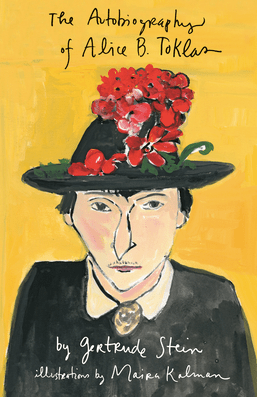
The Autobiography of Alice B. Toklas (1933) has a new edition this year (2020) which is beautifully illustrated by Maira Kalman. 

This autobiography tells of Stein before she arrived in Paris, when she arrived in Paris, the First World War, and after the war. The war years are interesting, when Stein and Toklas volunteered for the American Fund for the French Wounded to help the war effort by driving around France, cranking up the car to get it to start. 

It is predominantly though about Stein’s interest in art and artists, books and authors, and her long walks. She thinks Ernest Hemingway was ‘an extraordinarily good-looking’ 23-year-old with a ‘very good instinct for finding apartments in strange but pleasing localities.’ Giving him advice on his writing, she tells Hemingway to ‘begin again and concentrate.’

But who did Gertrude Stein and Alice B. Toklas know? Ernest Hemingway, Paul Cezanne, Henri Matisse, Pablo Picasso, Sylvia Beach, Guillaume Apollinaire, Isadora Duncan, Ford Madox Ford … EVERYBODY. Their apartment was a social hub for creatives. 

The focus of this autobiography is on Stein, through the voice of Alice B. Toklas. Although, as the book states, ‘don’t be deceived by Alice always in the background. Nothing would have happened without Alice. NO THING.’

Gertrude Stein’s own writing was originally criticized by her friends and acquaintances because they didn’t like the way they were mentioned in her book – just as Hemingway was criticized for his 1964 memoir set in Paris, A Moveable Feast.

Poet and publisher T.S. Eliot famously said:

‘the work of Gertrude Stein was very fine but not for us.’

I think the work of Gertrude Stein is very fine and quite the autobiography for us (for us living in Paris, anyway). 

I like this style of autobiography: ‘This is a singular story embedded in a singular time.’ It is semi-colloquial, taking a few steps forward, then going back to add another point, then moving forward again. It is interesting for its descriptions, not only of people, but also of the artworks in their apartment, and for its depictions of artists before they were famous. 

Claude Monet and his Water Lilies

Claude Monet and his Water Lilies.

Water Lilies is not one painting. It is a series of paintings that French Impressionist Oscar-Claude Monet (1840-1926) worked on for thirty years, inspired by the water garden at his home in Giverny in Normandy. He created about 300 paintings of water lilies, with about forty in large format. There were also three tapestries.

Art critic Louis Gillet said Claude Monet’s paintings of Water Lilies (Nymphéas) are ‘without pattern, without borders.’ They are paintings with ‘no sky, no horizon, hardly any perspective or stable points of reference.’ This is true of course, but in two parts.

Monet devised two types of compositions with the water lilies theme: (1) the edge of the pond, seen in the Water Lily Pond (Bassins aux nymphéas) of 1899-1900, and (2) only the water surface with flowers and reflections in Japanese Bridge (Pont japonais) of the later years, including the Water Landscapes (Paysages d’eau) of 1903-1908.

When choosing to exhibit some of the paintings in the series, he chose a circular theme. The idea for a circular series began from 1897, but more in earnest from 1914, which Claude Monet called his ‘great decoration.’ 

The circular series is shown in the Musée de l’Orangerie (the Orangerie Museum) in Paris, in the Tuileries Garden in the first arrondissement. It is a panoramic frieze displayed in two elliptical rooms.

However, the exhibition’s journey from idea to actuality took many years. First, the location for the exhibition had to be determined. There was a long period deciding where to exhibit Claude Monet’s circular Water Lilies series, even proposing to put them in the Rodin Museum. The Musée de l’Orangerie was chosen for its location and west-to-east position.

In 1909, Claude Monet said,

‘those with nerves exhausted by work could relax there, following the restful example of those still waters, and, to whoever entered it, the room would provide a refuge of peaceful meditation in the middle of a flowering aquarium.’

Indeed, today, when you see the exhibition, it is indeed a refuge of peace. 

Claude Monet gave two panels of the paintings to the French State after the Armistice of 11 November 1918, as a symbol of peace, crowning the Water Lilies cycle. The dimensions of nearly one hundred meters, gives, as Monet said, the ‘illusion of an endless whole, of a wave with no horizon and no shore.’

The Water Lilies were finally displayed at the Musée de l’Orangerie from 1927. But Claude Monet’s circular series did not receive critical acclaim initially. In 1927, the avant-garde scene of the early 20th century undervalued Impressionism as an art form. So, not many people attended the Claude Monet exhibition. 

One painting was damaged by a bomb shell during the Liberation of Paris in 1944-1945. It wasn’t until the 1960s that the Musée de l’Orangerie was renovated. However, neither the original museum exhibition design in the late 1920s nor the 1960s renovation included Claude Monet’s exact specifications for displaying his paintings to their best advantage. 

Today, the permanent exhibition at the Musée de l’Orangerie presents eight of Claude Monet’s great Water Lilies compositions in the circular series, created of large panels assembled side by side. They are hung across the curved walls of two elliptical rooms. They are hung to Claude Monet’s exact specifications, that he dictated before 1927. The specifications included the positioning and spacing between the panels. Monet also specified that there should be natural lighting coming down from the roof. 

The Musée de l’Orangerie was renovated from 2000-2006 to restore the zenithal lighting that Monet had originally specified. When you visit the museum, look carefully at Claude Monet’s circular series of Water Lilies, and look up at the lighting. 


This image has an empty alt attribute; its file name is IMG_8454.jpg

A night at the Odéon in Paris.

Last night, I had the pleasure of attending a performance of L’Hôtel du Libre-Échange at the Odéon–Théâtre de l’Europe in Paris. This experience was an immersion into the world of classic French vaudeville, set against the backdrop of one of Paris’s most historic theatres.

Located in the 6th arrondissement, near the Luxembourg Gardens, the Odéon–Théâtre de l’Europe is rich in culture and history. Inaugurated in 1782, it is one of France’s six national theatres and the oldest theatre-monument in Europe still operating in its original premises. Its neoclassical architecture and Italian-style auditorium provide a grand setting for theatrical performances.


This image has an empty alt attribute; its file name is IMG_8445-1024x768.jpg

This image has an empty alt attribute; its file name is IMG_8451-1024x768.jpg

Written by Georges Feydeau and Maurice Desvallières in 1894, L’Hôtel du Libre-Échange (The Free Trade Hotel) is a quintessential French farce that intertwines themes of desire, deception, and societal norms. The play is about Monsieur Pinglet and Madame Paillardin, both seeking extramarital escapades at the discreet Hôtel du Libre-Échange. Unbeknownst to them, a series of misunderstandings and unexpected arrivals, including their respective spouses, lead to many comedic situations.

The current production, directed by Stanislas Nordey, reinvents the classic. Nordey’s direction emphasizes the play’s “ballet of frustrations” where timing and physical comedy are paramount. The ensemble cast delivers wonderful performances, capturing the essence of Feydeau’s work and the absurdity of the situations. Performances run until 13 June 2025. 

This image has an empty alt attribute; its file name is IMG_8455-1024x768.jpg

This image has an empty alt attribute; its file name is IMG_8456-1024x768.jpg

Attending a play at the Odéon is not just about the performance; it’s about experiencing a piece of Parisian culture and history. The theatre’s ambiance offers an unforgettable evening. 

This image has an empty alt attribute; its file name is IMG_8453-1024x768.jpg


This image has an empty alt attribute; its file name is Front-Cover-6x9in-683x1024.jpg

Parisian architecture: ‘castles in the air’

Parisian architecture: ‘castles in the air.’ 

In May 2015, the mayor of Paris Anne Hidalgo, wrote an article in Politico stating that the French capital has become a testing ground for new technologies. She headlined the article, in English, ‘Parisian castles in the air.’ It is an interesting headline. France is famous for its castles – on the ground. 

The phrase ‘castles in the air’ in English refers to dreams about future success. The online Free Dictionary adds another meaning: ‘plans or hopes that have very little chance of happening.’ American singer Don McLean composed a song called Castles in the Air in 1970, and re-released it in 1981. It’s about a girlfriend he wants to leave:

And if she asks you why, you can tell her that I told you

That I’m tired of castles in the air

I’ve got a dream I want the world to share

And castle walls just lead me to despair

McLean is not hopeful of success. 

In her article, the mayor of Paris describes the city as an ‘open-air laboratory’ adding that the Council of Paris is preparing to ‘make crucial decisions that will ensure Paris remains a smart and sustainable city’ through its ‘innovative approach to urban design.’ She highlights previous buildings and infrastructure, with innovative designs, that include the Haussmann architecture, the electricity network, and the metro, as well as new ways of living in urban spaces, such as the bicycle systems the Velib and Autolib (to reduce the number of cars in the city). She also mentions the modern architecture of the Les Halles complex and the striking new Law Courts project. 

None of her examples include the famous castles near Paris, now tourist attractions: the Château de Versailles and Château de Fontainbleau. These are real castles with long histories.

The mayor of Paris also includes a Henry David Thoreau quote in her article: ‘If you have built castles in the air, one day, our work need not be lost; that is where they should be. Now put the foundations under them’ and she concludes with: ‘This is what we [the Council of Paris] are doing in Paris, imagining and implementing new possibilities at the human level, laying the foundations for our dreams.’ Hence, she is directly referencing a American author Henry David Thoreau (1817-1862) about castles in the air as dreams, but building foundations to support those dreams.

The Thoreau reference is interesting, because he wrote an essay titled ‘Civil Disobedience’ which was originally titled ‘Resistance to Civil Government.’ He was also regarded as an environmentalist. His father was a pencil maker and his father’s father was born in Jersey, the island between the United Kingdom and France. It is not UK-owned; it is self-governing, but it is only a stone’s throw, at only 22 kilometres, from the coast of Normandy, France.

The mayor’s article with its use of imagery that re-imagines history while also discussing the future of architecture and urban planning in Paris is a fascinating juxtaposition of ideas. The mayor reassures readers that past glories in Parisian architecture will always be celebrated, and the daring concepts of the future will have the foundation, or basis, for establishing lasting infrastructure that residents and tourists will also take to their hearts.

Since this article, the mayor has spoken of Paris aligning its new infrastructure with the Paris Agreement – the climate agreement to transition to low carbon emissions.

What has Paris done in the last five years to start building these castles in the air? One project, an ambitious project, is the new subway, described as ‘the most ambitious new subway project in the Western world’ by Henry Grabar in 2016. It is the expansion of the Paris Métro, which aims to be completed by 2030. Its goals include: to reduce car traffic in Paris, link business districts with airports and universities, and ‘ease social ills by knitting together the French capital’s isolated and troubled banlieues [suburbs].’

But just outside of the city limits of Paris, in La Défense, seven new skyscapers are planned, and some have commenced construction, with completions due in 2021 and 2022, as part of a strategy to bring business back to Paris. The aim is to cater to bankers, academics, and researchers from overseas to set up camp in Paris. I doubt whether these high-rise glass and steel buildings can be called castles, but they will be in the air!

For the Parisian love of carousels

For the Parisian love of carousels.

The French love the carousel, the merry-go-round: le carrousel, la manège. And I love them too. 

The turning-rides and round-abouts may have been around since Roman times, but the English word ‘carousel’ originated from the French word. It originated from an eccentric 18th century Frenchman, Guillaume Joseph Roussel (1743-1807), known as Cadet Roussel. He was a bailiff in the city of Auxerre, where, it is said, he lived in a small, curious house or three. This inspired the lengthy, mocking, childhood folk song, written in 1792, about him, which is sung to the tune of Gaspard de Chenu’s song Jean de Nivelle. The first verse is: 

Cadet ROUSSELLE has three houses, 

That have no beams or rafters,

It’s to house the swallows.

What will you say about Cadet ROUSSELLE?

Ah! Ah! Ah! but really,

Cadet ROUSSELLE is a good child.

And so, visitors to Paris may wonder why the Carrousel Garden in the Tuileries Garden near the Louvre in the 1st arrondissement is so called. There is a carousel there, but it was called the Carousel Garden because of the Arc de Triomphe du Carrousel – the triumphal arch of the Carrousel. The Corinthian arch, built between 1806-1808 commemorates Napoleon Bonaparte’s military victories, as a sort of mini version of the famous Arc de Triomphe nearby. Specifically, it commemorates Napoleon’s victory of France at the Battle of Austerlitz in 1805 against the troops of the Russian Empire and the Austrian Empire.

But, as I said, there is a small, illuminated carousel there, called the Carousel of the Tuileries Garden, almost hidden in the trees. It even plays the music to the song ‘Cadet Roussel.’ 

Moving to the Trocadero in the 8th arrondissement, is the Carousel at Trocadero, affectionately called the Troca, on United Nations Avenue. It is close to the Eiffel Tower, so sitting on a galloping horse, children have a stunning view. The carousel itself is gilded with Romantic décor. Very retro, as all carousels are.


There are many carousels in Paris, and in fact, there are several in the Tuileries and in the Troca, as well as in other arrondissements.

However, my favourite is the Dodo Manège – the Dodo Merry-go-round – in the garden of plants, Jardin des Plantes, in the 5th arrondissement. It’s in the same grounds as the Natural History Museum, which may explain why, instead of galloping horses, it has prehistoric extinct animals and endangered ones. Which of course is a lesson in natural history as children go round-and-round.

A scientist created the Dodo Manège in 1992. The endangered animals include a gorilla (my favourite), a giraffe, and a panda. The extinct animals include a dodo (my favourite), the thylacine, a triceratops, a horned turtle, a glyptodon, a sivatherium, and an aepyornis. 

Everyone knows of the dodo, the big pigeon-like, duck-like, flightless bird that was endemic to Mauritius. Most children know the triceratops, the dinosaur, whose name means ‘three-horned face.’ The meiolania is much smaller and known as the horned turtle. The glyptodon is a massive armadillo with big teeth. 


A good proportion of people would have heard of the thylacine, but in its common name, the Tasmanian Tiger, from Australia. It looks like a striped dog, a bit like the dingo. 

The least well-known animals on the Dodo Manège are the sivatherium, a giraffe-like animal, and the aepyornis, another flightless bird.

Most carousels in Paris move anti-clockwise, but one in the Tuileries moves clockwise. Take a look at one in your country or your city – does it move clockwise or anti-clockwise?