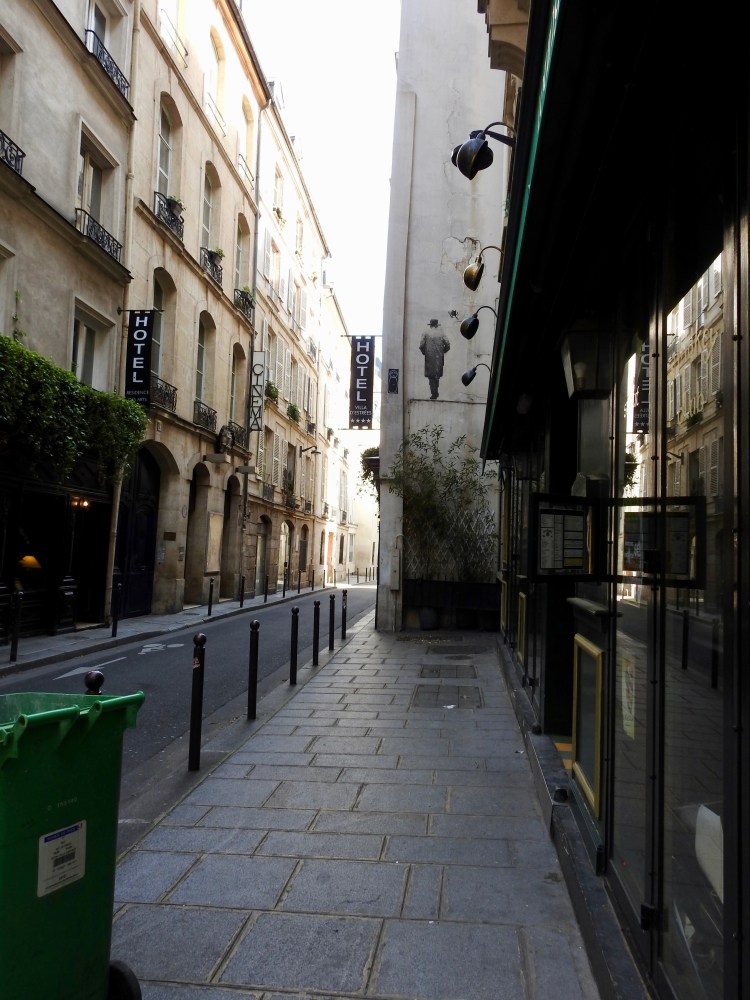
Today I am looking for that frock from Le Bon Marché.
I don’t know what that frock looks like, except that it would be circa 1904 and matches a coral necklace. I can’t be specific about the date of the dress.
‘I wore that frock from the B Marche paris and the coral necklace …’
Those are the words of Molly Bloom in James Joyce’s novel Ulysses. Molly says her father’s friend, Mrs Stanhope, sent it to her. Lucky Molly! The ‘B Marche paris’ is, of course, Le Bon Marché River Gauche, the large department store on the corner of three streets: rue de Sèvres, rue de Babylone, and rue du Bac in the 7th arrondissement of Paris.
Le Bon Marché was founded in 1838, and completely remodeled into the current opulent building opened in 1852. The novel Ulysses is set on one day: 16 June 1904. This is two years after James Joyce first went to Paris as a twenty-year old in 1902.
It wasn’t until 1920 that Joyce returned to Paris. He commenced Ulysses in 1914, and it was completed and published in Paris in 1922.
Rather cleverly, Joyce had Molly refer to the dress as ‘that frock’—which makes the date fluid. It is even possible ‘that frock’ was from 1903, but I think 1904 is more likely.
James and Nora Joyce once lived in the Hotel Victoria Palace at 6 rue Blaise Desgoffe, a ten-minute walk from Le Bon Marché. For a whole year, actually, from August 1923 to October 1924, although notably after the publication of Ulysses. From the Hotel Lutetia on the Boulevard Raspail where they stayed at the end of 1939, before evacuating Paris due to the war, Le Bon Marché is a mere five-minute walk down the street. It is such a grand store that Nora would definitely have visited whenever her husband was paid royalties for his writings.
I depart from the vicinity of the Luxembourg Garden and travel along rue de Vaugirard, a long and interesting street. But I am not travelling its full distance. I cross Boulevard Raspail and rue de Rennes and head down rue Saint-Placide to rue de Sèvres.
Even before I see the impressive building of Le Bon Marché, I see the snaking line of masked customers, keeping one-metre social distancing, before entering in limited numbers. The two-month lockdown in France due to the Coronavirus pandemic was lifted on 11 May, but rules and restrictions apply, taking the fun out of shopping. Having visited Le Bon Marché multiple times, I don’t enter today.
Aristide and Marguerite Boucicaut instigated the construction of Le Bon Marché and commissioned architect Louis-Charles Boileau and engineer Gustave Eiffel—of Eiffel Tower fame. It was the first department store in the world, and therefore worth a visit in its own right. The three-floor mall-style building has a simple façade, because the focus was on the feature-laden interior.
In any case, I would hardly find a turn-of the-20th-century frock in the store today, but I was looking for an excuse to shop. A coral necklace would certainly have been found. In this case, I prefer to shop in boutique stores along rue Saint-Placide—a far less restrictive experience.
Today I am looking for gold skinned men in Paris. Not golden statues, although there are many of those, and they are easy to be found.
I’m reading James Joyce’s Ulysses, Episode 2, Nestor:
‘On the step of the Paris stock exchange the goldskinned men quoting prices on their gemmed fingers. Gabble of geese. They swarmed loud, uncouth about the temple, their heads thickplotting under maladroit silk hats. Not theirs: these clothes, this speech, these gestures.’
The Paris Stock Exchange is now not as it was a hundred years ago. It is the sign of progress.
In the time of James Joyce, completing Ulysses in Paris in 1922, the Paris Stock Exchange (Paris de Bourse) was already a hundred years old. It sprang from individual monopolistic market places and was transformed into the Paris Bourse as one large public place where the securities trade could be conducted.
The Paris Bourse building is actually called the Palais Brongniart. Before the building was erected, market places were evident since 1724, and stock exchange activities occurred in the Vivienne Gallery of the Mazarin Palace until 1793, and then in the Louvre, the Palais-Royal, inside the Church of Our Lady of Victories from 1796-1809, back in the Palais-Royal, and from 1818 in a building of the Convent of the Daughters of St. Thomas, a vast monastery extending from St. Augustine Street to Feydeau Street. Activities were also housed at the Commercial Court from 1826-1864 and the Paris Chamber of Commerce from 1826-1853.
The building of the Paris Stock Exchange—the Paris Bourse—began construction in 1808 in Brongniart Square in the 1starrondissement on the site of the Convent of the Daughters of St. Thomas. It was completed and opened on 4 November 1826, where it stands today.
‘The goldskinned men quoting prices’ used the open out-cry system—shouting out the prices, as Joyce says in Ulysses, like a gabble of geese ‘loud’ and ‘uncouth.’
The open out-cry system was used for 150 years in Paris, until the 1980s marked a time for reform—computerized reform. The open out-cry system became the integrated computer trading system while still keeping a limited version of the out-cry system. By 1989 the Paris Bourse was fully electronic.
Ten years later, in 1999, France’s four top financial institutions merged to become one new company, the Paris Bourse SBF SA. In 2000 the independent financial marketplace, the Paris Bourse, officially ended.
From 2000, Paris Bourse became Euronext Paris, part of Euronext and one of five consolidated pan-European exchanges: Paris, Amsterdam, Brussels, Lisbon, and London. All that Euronext Paris conducts is regulated by France’s Ministry of Economics, le Comité des Établissements de Crédit et des Entreprises d’Investissement (CECEI), the banking commission, and the Autorité des Marchés Financiers (AMF). Euronext became the fourth largest exchange in the world.
In 2007, Euronext merged with the New York Stock Exchange, becoming the NYSE Euronext. So, over a period of a hundred years, the financial marketplace that was once a disparate system has become a truly global marketplace.
I leave the Place de la Concorde to cross the rue de Rivoli and the rue Saint-Honoré to reach rue Cambon, named after Pierre-Joseph Cambon (1756-1820), the chair of the Finance Committee of the National Convention.
The building on Rue Cambon has arches that are now filled with iron doors and wrought iron railings. It is not a pretty building. And the building opposite—the Chanel building—is undergoing renovations. Overall, the street is noisy with jack-hammers and blocked with construction cranes.
But all is not lost. This is Chanel Cambon street. This is where Gabrielle (Coco) Chanel (1883-1971) started her millinery business. Hats. It all began with hats in the basement of the limestone building of number 21 in 1910, before she moved along the street to number 31 in 1918—point zero—THE Chanel store. A hundred years later, the firm purchased number 19, with a second entrance on rue Saint-Honoré. And renovations continue.
Coco Chanel was indeed of the same vintage as James Joyce (1882-1941). Born a year after Joyce, Chanel lived a healthier, wealthier, and longer life.
I imagine that the next time I am on rue Cambon, I’ll be seeing on the step of the Paris Chanel store the goldskinned women quoting prices on their gemmed fingers—or smart phones.
But, I digress, and I continue my way along rue Cambon to rue de la Madeleine. I turn right and then right again onto rue du Quatre September—Street of 4 September, where the current Paris Bourse is situated in the 2nd arrondissement.
The Paris Bourse building looms large and imposing. It is open to the public, but not today, a Sunday. Today, the old Paris Bourse is closed and locked. In James Joyce’s time, the building would not have been fenced. The steps would be open to all, and bustling with activity.
Today, there are no goldskinned men on the step of the Paris Stock Exchange. Not a one.
Catacombs, by definition, are morbid and mournful chambers for the dead. They are not burial places, for there is no dignity in death.
Catacombs are a city’s ossuary, a network of underground passageways filled with human bones, deposited and blessed with religious rites. Human-made, human-laid.
Paris has several ossuaries, and one is open to the public—at 2 Place Denfert-Rochereau in the 14tharrondissement.
Candle-lit visits into the Paris Catacombs ended with the installation of electricity in 1983.
Reported to be the largest repository of bones, there are estimated to be six million human remains in many kilometres of tunnels. The initial transfer of human bones was the two million Parisians from the Cemetery of the Innocents from 1785-86. Eventually, other bones were transferred from other cemeteries and churches in Paris to their resting place in the Paris Catacombs. The last transfer of bones to the Catacombs was in 1933.
There is no evidence that James Joyce visited the Catacombs, but his character Father Flynn did or at least knew of the ossuary.
James Joyce’s Dubliners (1914) is a collection of stories. The first story, called The Sisters is written in the first person. The narrator is a young, unnamed Irishman from Dublin, recalling his childhood friendship in 1895 with a Catholic priest, Father Flynn. Reverend James Flynn is dead at the age of sixty-five—after his third stroke. Not a figure in reality, Father Flynn, in the story, is representative of the Catholic Church.
The character of Father Flynn, from the perspective of a very young boy, is remembered for his knowledge and his story-telling.
‘He had studied in the Irish college in Rome and he had taught me to pronounce Latin properly. He had told me stories about the catacombs and about Napoleon Bonaparte, and he had explained to me the meaning of the different ceremonies of the Mass and of the different vestments worn by the priest.’
The Catacombs referred to in the passage from The Sisters is the Paris Catacombs. I ventured into the Paris Catacombs on 28 August 2018. Two kilometres of the Catacombs is available for viewing as a museum of tunnels. Descending 130 steps of the stairwell, the temperature dropped from a warm summer 26C to the constant underground temperature of 14C.
Narrow, damp, dank, the bricked tunnels are signed according to streets or galleries. A sign says: Vous êtes invité àne rien toucher, et àne pas fumer dans l’ossuaire—You are invited not to touch anything, and not to smoke in the ossuary.
Apart from the necessary rules, there are touches of poignancy:
Ainsi tout passe sur la terre
Esprit, beauté, grâces talent
Telles une fleur éphémère
Que renverse le moindre vent.
So, everything passes on earth
Spirit, beauty, talented graces
Like an ephemeral flower
That reverses the slightest wind.
There are no plaques to recognize individuals. There are no ‘whole’ skeletons. There are, however, plaques that identify which cemetery the bones originated from. Devoid of individuality, nameless celebrities and paupers are entangled together, forever.
There is no chance of getting lost in the Paris Catacombs. It is well-signed and well-directed from entrance to exit. For me, there was no hint of claustrophobia, nor airlessness either.
After forty-five minutes, the ‘tour’ is over, and the summer sun blinds.
Today, I’m looking for evidence of the Ulysses character, Kevin Egan, who is, in real-life, Joseph Theobald Carey, a friend of James Joyce. I am in rue Gît-le-Couer in the 6tharrondissement.
There is no grainy sand in rue Gît-le-Couer. No razorshells, no squeaking pebbles, no unwholesome sandflats. This is not the beach.
Stephen Dedalus, in Ulysses, is walking along Sandymount strand. The beach. In his monologue, he takes in the scenery, all that he sees and smells and hears and feels. But he is distracted, thinking about the time he met Kevin Egan in Paris.
Kevin Egan is exiled in Paris. His real persona is Joseph Theobald Carey (1846-1907), a revolutionary, a pro-Irish-independence fighter, seeking Ireland’s independence from Great Britain. In Paris, Carey is a typesetter, composing print for a newspaper. It’s not a clean job, at the typesetting machine for the New York Herald.
His wife left him and his son Patrice is a soldier in the French army—‘mon fils, soldier of France.’
‘Noon slumbers. Kevin Egan rolls gunpowder cigarettes through fingers smeared with printer’s ink, sipping his green fairy ….’
Joseph Carey is a drinker. His green fairy is absinthe. He lives at rue de la Goutte-d’Or in the Montmartre area. When James Joyce moved to Paris in 1902, they often met for a meal and a drink or two.
‘About us gobblers fork spiced beans down their gullets … Il est irlandais. Hollandais? Non fromage. Deux irlandais, nous, Irlande, vous savez ah, oui!’ He reminisces about the waitress who thought Carey wanted cheese hollandaise, as he tries to explain to her that they were two Irishmen, from Ireland. Irlandaise, not Hollandais.
‘In gay Paree he hides, Egan of Paris, unsought by any save by me. Making his day’s stations, the dingy printingcase, his three taverns, the Montmartre lair … Loveless, landless, wifeless. She is quite nicey comfy without her outcast man, madame in rue Gît-le-Couer, canary and two buck lodgers. Peachy cheeks, a zebra skirt, frisky as a young thing’s. Spurned and undespairing.’ – James Joyce’s, Ulysses(1922), Chapter 3, Proteus.
I am in rue Gît-le-Couer. It is an ancient side street, off rue Saint-André-des-Arts. It starts at rue Saint-André-des-Arts and finishes at Quai des Grands Augustins, straight into the river Seine. The street has changed its name multiple time, and once called rue des Noix—Walnut Street.
At the entrance of rue Gît-le-Couer is Corcoran’s Irish Pub on the corner of the rue Saint-André-des-Arts with Le Café Latin opposite. In prior Coronavirus pandemic times, high tables and stools would welcome outside diners and drinkers. There are no tables and chairs now, and the pub is shuttered.
On the same side of the street as the Irish Pub is the four-star Hotel Villa D’Estrées and the Hotel du Vieux Paris—Hotel Old Paris. On the same side as Le Café Latin is the Hotel Residence des Arts at number 14.
The three hotels retain features from the 17thcentury, but the street itself dates back to 1200. Further down is the narrowest of residences at only five metres, a former home of the Bishop of Paris. It’s cold and dark, yet it’s spring, but it is sheltered from the wind. The darkness of the street ends with the bright view of the Seine, like the light of an incoming train.
Sandwiched between Le Café Latin and the Hotel Residence des Arts is the boutique Saint-André-des-Arts Cinema with its arched entrance.
The French have a love for small independent cinemas. Many have only 30-50 seats. I wonder what social distancing will be like for these cinemas when the restrictions are lifted. Will people want to go again? I usually attend in off-peak times, such as the first session of the day, when less than ten people, mainly retired couples, accompany me. I like the art-house cinemas here on the Left Bank that screen the classics, the off-beat, and the cult or independent films with short runs.
Now, the street seems as seamy as old Joseph Casey, an unlikely friend of James Joyce on the surface—much older, more distant and anti-social, a criminal, lying low, living in the darkness. Yet, as Joyce says, through the thoughts of Stephen Dedalus, ‘To yoke me as his yokefellow, our crimes our common cause.’ Stephen Dedalus is wistful at the loss of Kevin Egan. James Joyce is wistful at the loss of Joseph Casey. Older than Joyce by thirty-six years, Casey died in 1907 at the age of 61. A reasonable life.
I don’t linger in the street. There is nothing open. The quiet, less travelled street is even quieter than usual. It is dead. I walk where James Joyce would have walked—to the light of the river.
Georgian film director, Beka Mikadze, has released the first short 2-minute trailer on his upcoming COVID-19 Pandemic documentary – Pandemia – to be broadcast in the near future.
Through my Georgian assistant, I was contacted by the Georgian-Canadian company, the Gantiadi Ethno Cultural Film Association (GECFA), in April 2020 regarding an interview for their COVID-19 documentary.
Its aim is to focus on 25 people from 20 countries and their experiences with their nation’s response to the Coronavirus pandemic – the lockdown, the confinement, the cases, the deaths, and how the interviewees are coping with this strange new world.
The aim is to provide a global insight into the human response to the crisis, to ‘preserve the moment and record genuine emotions of interesting people in 20 different countries,’ Beka said.
I am a British-Australian, living in Tbilisi, Georgia, for the past ten years, and in lockdown in Paris, France, from March to May.
My interview, in Paris, was on 26 April 2020 with Beka Mikadze and his colleague Fred Sengmueller via Skype.
I spoke of the current situation, the French government’s strict confinement regulations, the French people’s attitude to the restrictions, my feelings, the importance of family and friends, the current ‘heroes’ and society’s attitude towards nature.
In the trailer, I am talking about what the word ‘emptiness’ means to me. Where is everyone?
By the way, people have asked me what ‘Opal Hush’ means—the title of these blog pages. Opal is a reference to my Australian life, and my favourite gemstone. Hush is a reference to secrets, or information shared between people in close proximity. Opal Hush is also a drink, and society-set, mentioned in James Joyce’s Ulysses (1922). Opal Hush is a drink of a quarter of a glass of claret, topped with lemonade from a soda siphon—a diluted form of alcoholic consumption.
Days after President Macron lifted the two-month ‘deconfinement’ of citizens for their protection during the Coronavirus pandemic, I’ve resumed walking more than the previously imposed one-kilometre distance.
During the two months, citizens required a permission slip with name, age, address, and reason for being outside. It was the government’s official attestation de déplacement dérogotoire, printed, on mobile phone, or hand-written, required for every journey for shopping, visiting the pharmacy or doctor, or exercising within prescribed times. Essential workers needed an additional company signature on their forms, and police issued fines for flouting regulations.
On 7 May, the government lifted the lockdown that commenced on 14 March. The lifting in gradual phases started on Monday 11 May, due to the declining number of COVID-19 cases, and declining number of deaths. Looking at the figures today, the documented number of confirmed cases is 140,227 with 57,785 people recovered, and 26,991 deaths nationwide.
Cafés, bars, restaurants cannot open, except for take-away kiosks. Shops can open with health and safety regulations in place, such as sanitizer gel at the entrance, social distancing of one metre, a limited number of customers to avoid contact, clear Perspex barriers at the till, and non-contact payment systems. Facial coverings, such as materials, scarves, or cloth masks are compulsory on public transport, but not elsewhere, although shop staff can request that customers wear them.
With all these measures to prevent the spread of the virus, any freedom feels like a release. Not all people are ready to rush into the streets though; anxiety is still high; and the uncertainty about the future, and any potential second wave, with increased new cases, make some people nervous.
With no attestation paper, and permitted to travel up to 100 kilometres without it, I take a face covering, but I don’t wear it on the streets. It’s around my neck so that I can easily pull it over my mouth and nose if I enter a shop.
So, today I’m looking for gargoyles. Specifically, I’m looking for a “gargoyle face” on rue Saint-André-des-Arts.
“Harsh gargoyle face that warred against me over our mess of hash of lights in rue Saint-André-des-Arts. In words of words for words, palabras. Oisin with Patrick. Faunman he met in Clamart woods, brandishing a winebottle. C’est vendredi saint! Murthering Irish. His image, wandering, he met. I mine. I met a fool i’the forest.”
The paragraph is from James Joyce’s, Ulysses (1922), Chapter 9, Scylla and Charybdis. The main character, Stephen Dedalus, is walking with Malachi (Buck) Mulligan, discussing Shakespeare’s writing. Buck Mulligan jokes about the writing style of Irish playwright John Millington Synge, which evokes Stephen’s recollection of meeting him in Paris. He thinks to himself that Synge has a “harsh gargoyle face.”
It’s spring in Paris now, and cool at 13C, with 17C predicted. An irritating wind whips the leaves and dust into the air. The usual bustling and noisy Rue Saint-André-des-Arts is virtually empty. The virus still keeps people inside.
Rue Saint-André-des-Arts in the Monnaie district of the 6th arrondissement, largely free of traffic, despite its prime location, has a mixture of shops, from the small international cuisine kiosks at the entrance at Place Saint-André-des-Arts to quaint and trendy clothes shops, including vintage clothes in the mid-section. Although it is a short street, there are cafés, restaurants, and an Irish Pub—all closed today, except for the take-away sandwich stall.
It runs parallel to the river Seine and is close to the Notre Dame Cathedral. The street was named after a church, that no longer exits. Once a hub for artists and cinema goers, the street is now mostly frequented by tourists, drinkers and diners.
Dating back to the 15th century, buildings still have some traditional features, such as exposed beams, wrought iron railings, corniches, carved doors, and narrow facades.
As I wander slowly along the street, I look up at the buildings, looking for any gargoyle, not initially one that looks like John Millington Synge. But, the one gargoyle male face that I find is indeed like that of Dublin-born Edmund John Millington Synge (1871-1909). I see the resemblance now: the nose, the moustache.
Synge was living in Paris from 1896. James Joyce left Dublin for Paris in 1902 after graduating from the University College Dublin.
So, in reality, Joyce and Synge did meet in Paris in 1903, and they did walk along the narrow rue Saint-André-des-Arts.
Lady Augusta Gregory (1852-1932), an Irish dramatist and theatre manager, arranged for 20-year-old Joyce to meet the 31-year-old Synge in Paris in 1903. In Gordon Bowker’s James Joyce: A Biography (2011), he says that Synge had returned to his Paris apartment after a holiday in the Aran Isles, and intended to return to Ireland.
Joyce gave Lady Gregory the Paris address of the Hotel Corneille, opposite the Odéon Theatre on the rue de Corneille, which is now the Odéon Hotel, a ten-minute towards the Luxembourg Garden.
Synge arranged to meet Joyce in the Odéon Cloister: ‘It was an appropriate enough meeting place, under the colonnade of a great theatre lined with bookstalls.’
Sylvia Beach’s Shakespeare and Company English-language bookstore was not there yet. She established it in 1919 at 8 rue Dupuytren before moving to larger premises at 12 rue de l’Odéon in 1922. Nor was Adrienne Monnier’s bookstore, La Maison des Amis des Livres, which she established at 7 rue de l’Odéon in 1915.
John Millington Synge was described as ‘a tall, dark, brooding man.’ Joyce and Synge met regularly for lunch, arguing about literature: ‘Synge, aggressively opinionated, garrulous and edgy; Joyce, scholarly and erudite.’
After a week together, Synge wrote to Lady Gregory about James Joyce:
‘He seems to be pretty badly off, and is wandering around Paris rather unbrushed and rather indolent, spending his studious moments in the National Library reading Ben Jonson. French literature I understand is beneath him! Still he interested me a good deal and as he is being gradually won over by the charm of French life, his time in Paris is not wasted. He talks of coming back to Dublin in the summer to live there on journalism while he does his serious work at his leisure. I cannot think that he will ever be a poet of importance, but his intellect is extraordinarily keen and if he keeps fairly sane he ought to do excellent essay-writing.’
Unfortunately, Synge never got to eat his words.
In the paragraph in Ulysses, the French sentence, C’est vendredi saint! means It’s Good Friday! In April, a month after meeting Synge, James Joyce attended Tenebrae at the Notre-Dame Cathedral on all three nights before Good Friday, which was on 10 April in 1903, ‘walking back to the Corneille afterwards through the gaslit streets.’ But on Good Friday, Joyce received a telegram from his father in Dublin telling him to come home because his mother was dying.
Both James Joyce and John Millington Synge returned to Dublin in 1903. Not yet Joyce’s girlfriend, Nora Barnacle acted the part of Cathleen in Synge’s play Riders to the Sea, performed for the first time in Dublin in February 1904. He wrote it when he lived in Paris. Joyce took a great deal of notice in Nora, and was impressed with her rendition.
Although this period was only one year, Joyce returned to Paris in 1920 with Nora and their two children, Giorgio and Lucia, and stayed for twenty years.
It was a different story for Synge. The photograph of Synge, shown here, is circa 1907. He died in 1909, at the age of 37, from Hodgkin’s disease, which apparently was the reason for his grumpiness and intolerance of many artists, but not Joyce whom he admired, despite their heated arguments. Joyce felt ‘haunted’ by Synge’s untimely death, ‘a creative life cut short with so much left unwritten.’
By the way, John Millington Synge reminds me of the actor Kiefer Sutherland or even his actor father Donald Sutherland. Neither were born in Ireland: Donald (1935-), born in Canada, is of Scottish, English, and German ancestry and his son Keifer (1966-) was born in England and also has Canadian citizenship. Frequently, they play Irish roles, and would have looked quite like Synge at the cinema in rue Saint-André-des-Arts.
Donald Sutherland, John Millington Synge, Keifer Sutherland